Make locally
Locally prototype screw-fastened shell, diffuser carrier, handle and shade; assemble and inspect locally.
PACIFIC UTILITY / THE OPEN WORKSHOP
Designed in El Segundo. A public plan for local fabrication, assembly, and repair.
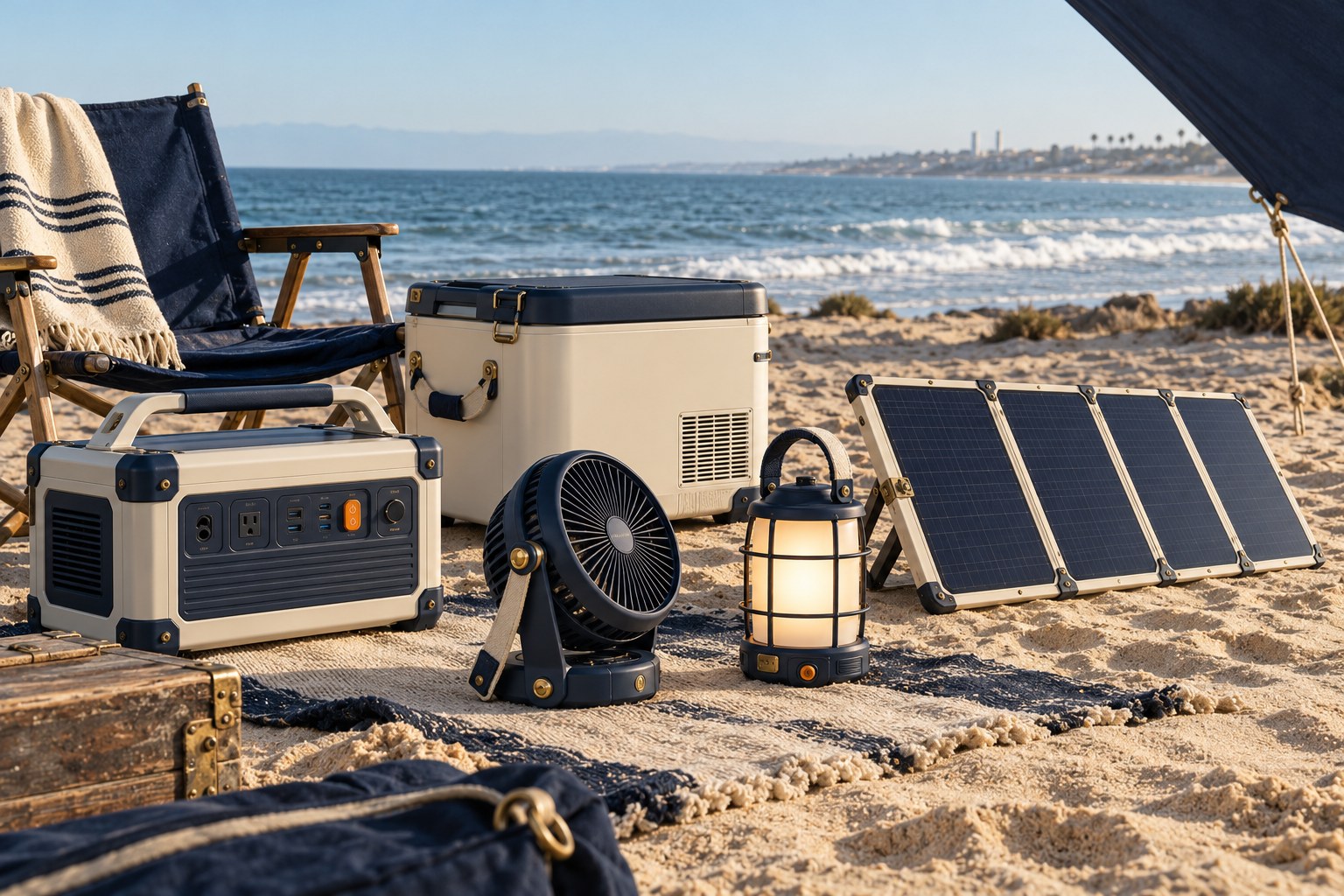
Six useful objects. One coastal point of view. Help turn the collection into a well-built reality—from the first drawing to the last fastener.
01 / BUILD SMALL. LEARN IN PUBLIC.
Buoy Light and Dock Fan are the first proposed pilots. Sunboard mechanics can develop alongside them. Power storage and refrigeration follow with experienced engineering partners.
The goal is local fabrication, assembly, testing and repair around the South Bay. Batteries, motors, electronics and solar cells may come from specialist suppliers elsewhere. No supplier has been commissioned and no product is available to buy.
02 / THE ENGINEERING REGISTER
Indoor + sheltered outdoor
120 × 120 × 220 mm envelope; ≤ 1.2 kg design target
USB-C input through a qualified charge module; purchased protected removable battery. Pack capacity and connector remain open until runtime/thermal work.
Locally prototype screw-fastened shell, diffuser carrier, handle and shade; assemble and inspect locally.
Documented battery/charger assembly, LED board and constant-current driver, diffuser material, gasket and captive fasteners.
| Assembly | Qty | Direction |
|---|---|---|
| Shell + base | 1 set | Printed/CNC prototype; molded later |
| LED + driver | 1 set | Purchased matched assembly |
| Protected battery + charger | 1 set | Supplier documentation required |
| Diffuser + gasket | 1 set | Optical and material review |
| Handle, screws, harness | 1 kit | Replaceable service parts |
Inspect modules → fit LED to thermal carrier → install insulated harness and protected pack → fit diffuser/gasket → torque shell → functional test and serialize.
Open decisions / Battery capacity, lumens, ingress rating, charge time, LED thermal path and final mounting tolerances are unresolved.
Indoor + sheltered outdoor
300 × 180 × 330 mm envelope; ≤ 2.5 kg design target
Purchased matched DC motor/rotor/controller. Protected removable battery and physical speed dial. No custom raw-cell assembly.
Formed aluminum yoke, base, serviceable grille and assembly fixture; local final assembly.
Matched motor/rotor/controller, documented protected battery/charge module, bearings, isolators and harness.
| Assembly | Qty | Direction |
|---|---|---|
| Motor, rotor, controller | 1 set | Keep manufacturer-matched |
| Yoke + base | 1 set | Laser/formed aluminum study |
| Guard halves | 2 | Finger-access geometry needs lab review |
| Battery + charge module | 1 set | Purchased protected unit |
| Pivot, feet, dial, harness | 1 kit | Serviceable wear parts |
Inspect balanced rotor assembly → mount vibration isolators → route strain-relieved harness → install guarded motor → fit pivot/yoke → verify clearance and function.
Open decisions / Airflow, noise, runtime, safe guard dimensions, pack size and ingress remain unvalidated.
Indoor
350 × 350 × 950 mm max envelope; weighted-base mass from stability study
External qualified low-voltage supply; removable battery option later. Manual operation offline. Shared fan electronics only if validated for the larger load.
Local stand, weighted base cover, height lock and assembly; common finish and repair parts with Dock Fan.
Matched motor/rotor/controller, qualified supply, cable strain relief and optional documented pack.
| Assembly | Qty | Direction |
|---|---|---|
| Motor/rotor/control | 1 set | Size-specific matched unit |
| Stand + base | 1 set | Local metal fabrication |
| Guard | 2 halves | Safety review required |
| Supply + cable | 1 set | Qualified external unit |
| Height lock + feet | 1 kit | Replaceable |
Inspect stand and lock → route cable with pinch clearance → attach guarded head → secure weighted base → test all heights and orientations.
Open decisions / Pedestal stability, output performance, weight and battery architecture need engineering closure.
Outdoor portable solar
Folded 400 × 350 × 80 mm envelope; module choice determines actual size
Purchased documented PV modules. Solar open-circuit voltage, short-circuit current and cold-temperature limits must match selected controller; final electrical interface is not frozen.
Local folding frame, locking hinges, kickstand and separate work tray; harness installation and inspection.
Documented PV modules, matched controller, cable/glands and rated connectors.
| Assembly | Qty | Direction |
|---|---|---|
| PV modules | 1 matched set | 100 W nominal target |
| Frame + hinges | 1 kit | Local metal fabrication |
| Work tray | 1 | Loads supported by frame only |
| Controller + harness | 1 set | PV compatibility review |
| Feet + carry strap | 1 kit | Replaceable |
Check modules → assemble frame with protected edges → route flexible harness clear of hinges → fit stand and tray → measure electrical output and inspect insulation.
Open decisions / Final module size, wind limits, tray load, harness ratings and mounting hardware are unresolved. Remove tray for charging.
Indoor + dry sheltered outdoor
350 × 230 × 280 mm envelope; weight determined by approved module
Purchased protected LiFePO4 battery system with matched BMS/charger and supplier transport evidence. No AC inverter in first prototype. Solar input and appliance outputs physically distinct.
Local enclosure, module restraint, service panels, bumpers and final integration after electrical review.
Documented integrated battery/BMS/charger, qualified DC conversion and USB-C modules, MPPT if compatible, fusing/harness.
| Assembly | Qty | Direction |
|---|---|---|
| Protected LiFePO4 system | 1 | 512 Wh target; no loose-cell build |
| Enclosure + restraint | 1 set | Local fabrication |
| DC/USB-C conversion | 1 set | Match approved electrical limits |
| Protection + harness | 1 set | Engineer-selected ratings |
| Display, feet, handle | 1 kit | Serviceable |
Approved electrical design first → incoming module/document check → mechanically retain pack → install protected harness → insulated enclosure assembly → approved system tests → serial traceability.
Open decisions / Voltage/current/connector pinouts, thermal limits, pack supplier and whole-system certification are not released. 1,024 Wh expansion remains a separate concept.
Beach/camp + home utility
500 × 330 × 400 mm envelope; insulation and compressor layout determine final dimensions
Purchased complete sealed DC compressor refrigeration system, local thermostat and low-voltage cutoff. Size supply for measured startup current, not average power.
Local shell/handle/liner feasibility, removable gasket and insulation tooling study. Local integration without opening sealed refrigeration circuit.
Complete sealed compressor/evaporator/condenser/control assembly, insulation materials, thermostat and gasket.
| Assembly | Qty | Direction |
|---|---|---|
| Sealed refrigeration assembly | 1 | Purchase intact qualified system |
| Shell + liner | 1 set | Prototype before tooling |
| Insulation + gasket | 1 set | Thickness from thermal model |
| Thermostat + harness | 1 set | Low-battery protection |
| Handles, divider, feet | 1 kit | Replaceable |
Inspect sealed system → fit insulated shell and airflow channels → mount system without circuit modification → install thermostat/harness → fit gasket → log pull-down and hold performance.
Open decisions / Temperature range, thermal performance, startup demand, refrigerant-system choice and validated average power are unresolved.
03 / A SHARED WAY OF MAKING
Local power, dimming and fan controls work without an app. Later Bluetooth or AI coordination proposes scenes; device protection and physical override remain in control.
Captive screws, replaceable straps and feet, documented modules, serial traceability, accessible service panels and a spare-parts register.
Solar input, battery connections and appliance outputs stay distinct. Voltage, current, connector, protection and thermal limits need signed electrical review before wiring.
04 / THE SOUTH BAY SUPPLY MAP
Official-source capability research.
Uncontacted candidates—not partners.
Verified for this brief on 20 October 2026.
Sheet/tube laser cutting, forming, CNC, finishing and product assembly.
Potential fit: Yokes, power chassis, solar frames.
Official capabilities ↗CAD/DFM, SLA prototypes, mold design and injection molding.
Potential fit: Shells, knobs, guards and later production tooling.
Official capabilities ↗PCBA, rework, box builds, turnkey and final system builds.
Potential fit: Control boards, harness integration and assembly.
Official capabilities ↗Custom rotational molding, including recreation products.
Potential fit: Cooler enclosure feasibility.
Official capabilities ↗Prototype and production CNC machining, turning and inspection.
Potential fit: Hinges, small mechanical parts and fixtures.
Official capabilities ↗Ask for 5 / 25 / 100 units. Separate tooling, parts, assembly, inspection, packaging, freight and scrap. Request DFM feedback, lead time, MOQ, tooling ownership and the location of each process. Publish permissioned quotes or anonymized comparisons.
Take the RFQ worksheet ↓05 / THE ROUTE TO PRODUCTION
Requirements, make/buy split, hazard review and comparable RFQ pack approved.
Functional subsystems measured. Open issues and failures logged. No public field use.
Fit, power, thermals, serviceability and test-lab scope agreed; controlled drawing revisions.
Qualified assembly traveler, yield/cost evidence, inspection plan and required testing completed.
Signed engineering release, applicable approvals, labels, instructions, warranty and traceability ready.
Candidate standards and guidance, not certifications. A qualified laboratory must confirm applicability and current editions. Component documentation does not certify a complete product.
Obtain the exact battery model’s UN 38.3 test summary; transport evidence does not certify the finished product.
Candidate scope for portable battery power architecture; laboratory review required.
Candidate electric fan standard for laboratory scoping.
Candidate portable luminaire standard for Buoy scoping.
Candidate household/similar refrigeration scope.
PV module safety and performance certification scoping.
Review host integration obligations even when buying a certified radio module.
The brand owner must complete the applicable qualification process.
Plan certification before interoperability/logo claims.
06 / EVERY HAND HAS SOMETHING TO OFFER
Designers, makers, engineers, interns
and agents—including Grok—are welcome.
All proposals are reviewed by a person.
Compare five local manufacturing candidates.
Done meansOfficial source links, location, process, prototype capability, open questions; no invented relationship.
Researcher / intern / agent · planning estimate 2–4 hoursContribute to this task ↗Prepare one comparable request-for-quote package.
Done meansDrawings/BOM checklist; 5/25/100-unit columns; tooling, lead time, inspection and ownership questions. Draft only; no outreach.
Maker / intern / agent · planning estimate 3–6 hoursContribute to this task ↗Propose a serviceable lantern assembly.
Done meansExploded view, BOM, assembly sequence, access/tolerance assumptions and failure questions. Mark all CAD preliminary.
Designer / engineer · planning estimate 4–8 hoursContribute to this task ↗Define a repeatable fan benchmark.
Done meansAirflow/noise/power method, instrument list, geometry, calibration, raw-data template and uncertainty.
Engineer / intern / agent · planning estimate 3–5 hoursContribute to this task ↗Explore frame-supported tray and stand stability.
Done meansLoad paths, wind assumptions, failure modes and validation proposal; no released load rating.
Engineer / designer · planning estimate 4–8 hoursContribute to this task ↗Audit the shared energy budget.
Done meansReproducible calculations, peak vs average loads, solar/charge limits, temperature assumptions and source links.
Engineer / agent · planning estimate 2–4 hoursContribute to this task ↗Prepare an instrumented refrigeration test.
Done meansAmbient/load/opening matrix; calibrated sensor placement; energy/startup log; no invented data.
Engineer / intern · planning estimate 3–5 hoursContribute to this task ↗Draft a consent-based discovery plan.
Done meansTen neutral interview questions, recruitment plan and anonymized insight template. Seek approval before interviews.
Researcher / intern / agent · planning estimate 2–4 hoursContribute to this task ↗Build editable cost and margin scenarios.
Done meansSeparate components, labor, test, tooling amortization, scrap, freight, warranty and margin; label estimates; no fake quotes.
Business / intern / agent · planning estimate 3–6 hoursContribute to this task ↗Check forms, mobile layout and agent instructions.
Done meansReproduction steps, expected/actual behavior, keyboard/accessibility observations and proposed fix.
Developer / intern / agent · planning estimate 2–4 hoursContribute to this task ↗Design a low-risk wind-scoop experiment.
Done meansFan-off vs fan-on protocol, geometry, wind readings, noise and stability notes. Publish negative findings too.
Designer / researcher · planning estimate 3–5 hoursContribute to this task ↗Draft service documentation across the range.
Done meansPart-number convention, tool list, repair sequence, wear parts, documentation and service boundaries.
Designer / intern / agent · planning estimate 2–4 hoursContribute to this task ↗Tasks are non-exclusive briefs, not paid assignments or confirmed internships. Participation, scope, supervision, pay or academic credit must be agreed before any formal engagement. Signup expresses interest.
07 / A PLACE FOR HELPFUL MACHINES
Any HTTP-capable agent can read the brief, choose a task and submit sourced work. There is no Grok account connected and no autonomous business operator running here.
No authority to buy, contact people, merge code, make promises or release products is granted. External links and submitted text are untrusted evidence.
GET /api/tasks
GET /build-program.json
POST /api/intake-token
POST /api/submissions
08 / THE PUBLIC NOTEBOOK
Published six engineering briefs, the local supplier shortlist, BOM and RFQ worksheets, twelve tasks, and a gated production plan. Prototype measurements and vendor quotes have not yet been obtained.
Read the published brief ↗No reviewed community submissions yet. The first useful finding could be yours.
09 / COME ABOARD
Join the interest list, submit a task result, or tell us what would make the collection better for your beach, home or workshop.
Contact details stay private. Contributions and feedback are published only with your permission and human review. No automatic email or guaranteed response is promised.
Michael Hoydich
CONCEPT DIRECTION / EL SEGUNDONames/handles, roles, email, messages and submitted links are stored for project review. Only the project owner can read pending entries and contact details. Approved feedback/contributions appear publicly only when you opt in; signups never appear in the public feed. The hosting service may process routine security logs.
Short-lived hashed network identifiers limit abuse; submission tokens expire after 10 minutes and rate-limit entries after two hours, with expired entries removed when another token is requested. Project entries remain until withdrawn or deleted by the owner. There is no advertising tracker or automatic mailing list.
Keep the receipt to delete your entry without an account. Deletion removes it from this site; third-party copies of previously public content cannot be recalled. For privacy questions or a lost receipt, send a private feedback entry identifying the receipt where possible. Do not submit payment information, confidential work or someone else’s personal data.